 ORMA
ORMARehearse the full routine
Practise fastening, treating, walking and drinking at home. The station queue should never be the first full fitting.
 ← Back to Safety Library
Safety library / Access & transport
Prepare calmly, recognise fear or nausea early, and know when not boarding is the healthier choice.
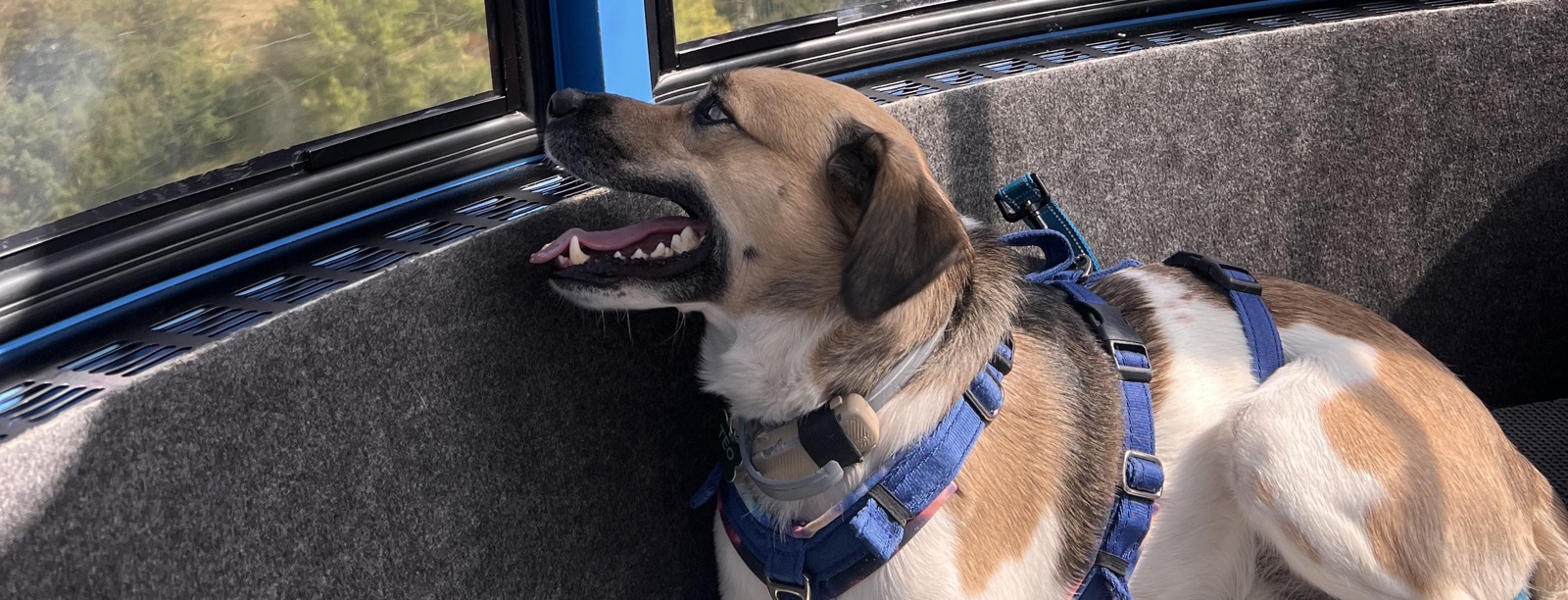
A gondola is a closed cabin. A chairlift is an open seat, metres above the ground, with a bar and nothing else. A dog that is not used to one can panic on the seat, and a dog that panics on a chairlift can fall. That has killed dogs.
ORMA therefore keeps routes that depend on a chairlift out of your recommendations unless two things are true: you have told us in the dog profile that your dog rides an open chairlift calmly, held on your lap, harnessed and leashed; and your dog weighs 8 kg or less, so it can be held for the whole ride. For every other dog such a route is graded as not recommended, whatever the walk itself is like.
If your dog qualifies, the route still carries a strong caution: check the lift is running, keep the harness and leash on, and hold the dog for the entire ride. Everything below is about closed cabins, where the risk is stress, not a fall.
A lift can remove a difficult climb, but the cabin itself must still feel manageable.
Practise fastening, treating, walking and drinking at home. The station queue should never be the first full fitting.
Watch the cabins from a comfortable distance, then leave before worry begins.
Choose a quiet time, a short journey and the least crowded cabin available.
Veterinary material consulted: Merck Veterinary Manual guidance on fear, anxiety and motion sickness in dogs, and the AVSAB humane dog-training statement. Operator policies checked: Cortina Skiworld, Lagazuoi, Val Gardena and Chamonix. Requirements can change by operator and season.
This is general information, not a diagnosis or a substitute for veterinary care.